Business storage is a flexible off-site storage solution used by companies to store stock, tools, equipment, documents, or surplus inventory without committing to long-term warehouse leases.
Instead of renting a full industrial unit or warehouse, companies use secure storage units or container facilities to manage overflow, seasonal stock, or operational equipment. Contracts are typically shorter, costs are predictable, and businesses can scale space up or down as needed.
In simple terms, it provides breathing room without the financial weight of permanent commercial premises.
Why More UK Companies Are Turning to Commercial Storage
Commercial property costs remain one of the largest overheads for small and mid-sized businesses. Long leases, deposits, utilities, business rates, and maintenance can quickly erode margins.
According to data from the UK Office for National Statistics, fixed property costs remain a significant pressure point for SMEs operating in competitive sectors.
Flexible storage space allows companies to:
- Reduce fixed overheads
- Avoid long lease commitments
- Scale storage as inventory grows
- Separate stock from office space
- Keep tools and equipment secure off-site
For many businesses, especially those in growth phases, that flexibility is invaluable.
When Should I Consider Business Storage?
Not every company needs a warehouse. But many reach a point where space becomes inefficient.
Business storage makes sense when:
- Your Office Is Becoming a Storeroom
If stock is filling meeting rooms or corridors, productivity suffers. Storage units for businesses allow you to reclaim workspace without relocating.
- You’re Paying for Space You Don’t Fully Use
Traditional warehousing often requires committing to more square footage than necessary. Flexible business storage allows you to rent only what you need, and adjust when circumstances change.
- You Experience Seasonal Demand
Retailers, ecommerce brands, and event companies often see peaks at Christmas or during summer. Short-term storage rental allows stock levels to expand without permanent costs.
- You’re Testing a New Market
Start-ups and scaling SMEs often hesitate to commit to industrial leases. Off-site storage space provides operational support while keeping financial risk low.
Who Typically Uses Storage Units for Businesses?
Trades & Contractors
Plumbers, electricians, builders, landscapers and maintenance teams frequently use container storage to secure tools and materials. It reduces the risk of theft from vans and keeps equipment organised.
Ecommerce & Online Retailers
Online sellers often outgrow spare rooms quickly. Secure storage facilities allow inventory to be organised properly, improving dispatch efficiency while keeping home and office environments clear.
Growing SMEs
Professional service firms, marketing agencies, manufacturers and importers frequently use commercial storage to house documents, archived files, promotional materials or surplus equipment.
It’s not always about stock. Sometimes it’s simply about space management.
Business Storage vs Traditional Warehousing
Before committing to additional space, it’s important to understand how flexible storage compares to traditional warehousing. The differences in cost, contract terms and responsibility can have a significant impact on how your business grows.
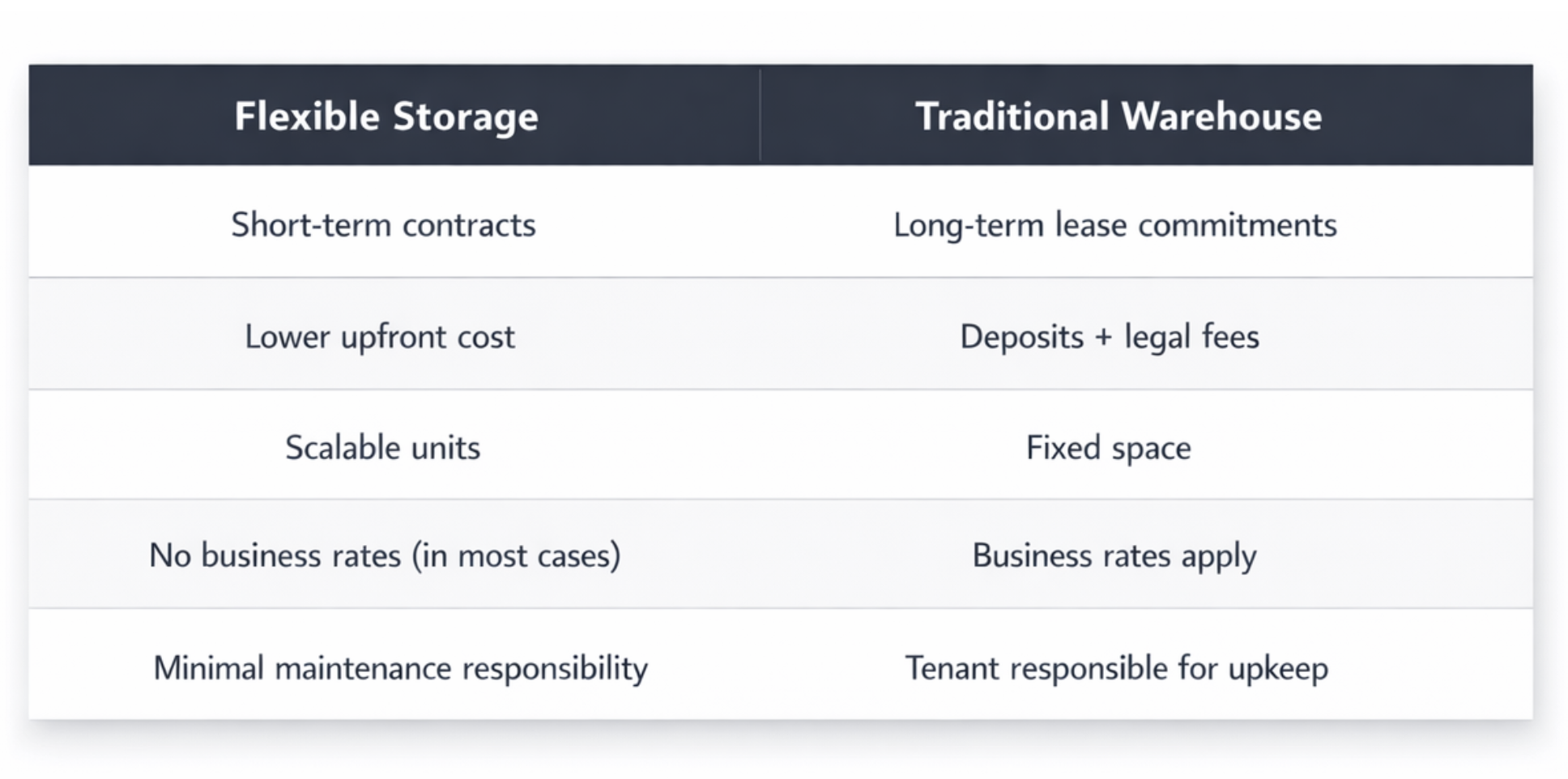
For smaller companies, warehousing can be disproportionate to actual need. Business storage units provide a middle ground of operational capability without the full industrial commitment.
Security: What Should Companies Expect?
Security is often the deciding factor. Reputable secure storage facilities should include:
- Perimeter fencing
- CCTV monitoring
- Controlled access systems
- Well-lit premises
- Individual unit locks
- On-site management presence
Industry best practice standards are influenced by organisations such as the British Security Industry Association, which sets guidance for security professionalism in the UK.
For businesses storing valuable tools, equipment or inventory, security should never be an afterthought.
If you’re evaluating costs, it’s also worth understanding what affects the pricing. Read this helpful guide on what people get wrong about storage costs.
Is Business Storage Cost-Effective?
Compared to traditional commercial property, flexible storage often eliminates:
- Long-term contractual liability
- Business rates
- Utility bills
- Maintenance costs
- Service charges
You’re paying for space, not a building. For many small companies, that distinction materially improves cash flow. Businesses operating from container storage also avoid the capital expenditure associated with fitting out industrial units.
If you’re specifically considering container-based options, you may also find this article rather helpful.
How to Decide If It’s Right for Your Company
Ask yourself:
- Is space limiting productivity?
- Are fixed property costs reducing flexibility?
- Do you need scalable storage?
- Would separating stock from office improve operations?
- Are you hesitant to commit to a long lease?
If the answer is yes to two or more, exploring commercial storage options is a logical next step.
The Bigger Strategic Picture
In 2026, agility matters more than ever. Markets shift quickly. Supply chains fluctuate. Consumer demand is unpredictable.
Business storage supports adaptability. It allows companies to:
- Operate lean
- Expand cautiously
- Manage risk
- Maintain professional organisation
- Protect valuable assets
For trades, ecommerce operators and growing SMEs, it offers something simple but powerful: control over space without overcommitting.
Final Thoughts
Business storage isn’t just about extra room. It’s about operational efficiency. For companies seeking flexible storage space without the burden of traditional commercial leases, it provides a practical, scalable solution.
Whether you need secure storage for tools, stock overflow, archived documents or seasonal equipment, the right facility can support growth, not restrict it. If you’re assessing options, take time to evaluate security, access, contract terms and scalability. The right choice should make your business lighter, not heavier.