Moving house is often seen as the obvious solution when your home starts to feel too small. You begin to notice it in small ways. Rooms feel tighter. Storage fills up faster. Everyday living takes a little more effort than it used to.
So the conclusion seems simple: you need more space. But in many cases, the issue isn’t how much space you have, it’s how that space is being used.
Before committing to the cost and disruption of moving house, it’s worth stepping back. Because what feels like a permanent problem is often something far more flexible.
Why So Many People End Up Moving House
There are plenty of valid reasons for moving house.
- growing families
- working from home
- lifestyle changes
- location needs
But one of the most common, and least examined, is the feeling of “not enough room”.
That feeling can come from:
- clutter building over time
- rooms doing too many jobs
- poor layout or storage
- items that don’t need to be there year-round
When everything lives in the same space, that space becomes fixed.
And fixed space quickly starts to feel limited.
The Real Cost of Moving House in the UK
Moving house is often treated as a simple upgrade. In reality, it’s a significant financial commitment.
Costs can include:
- stamp duty (depending on property value)
- estate agent fees
- legal and conveyancing costs
- survey fees
- removals and logistics
According to the UK Government’s guidance on buying and selling property, these combined costs can quickly add up and should be factored into any decision to move.
Beyond money, there’s also time, stress, disruption and uncertainty Which is why it’s worth asking a different question first.
Thinking of Moving House? Ask These 3 Questions First
Before committing, it’s worth testing whether moving is actually the right solution.
- Is it space or layout?
Sometimes the issue isn’t how much space you have, but how it’s arranged.
Rooms that serve multiple purposes often feel smaller than they are.
- Is it clutter or capacity?
If every cupboard is full, the instinct is to assume you need more storage.
But often, the issue is that everything is being stored at once.
- Is it permanent or seasonal?
Not everything needs to live in your home all year round. Seasonal items, archived paperwork and occasional-use belongings can create constant pressure if they’re always present.
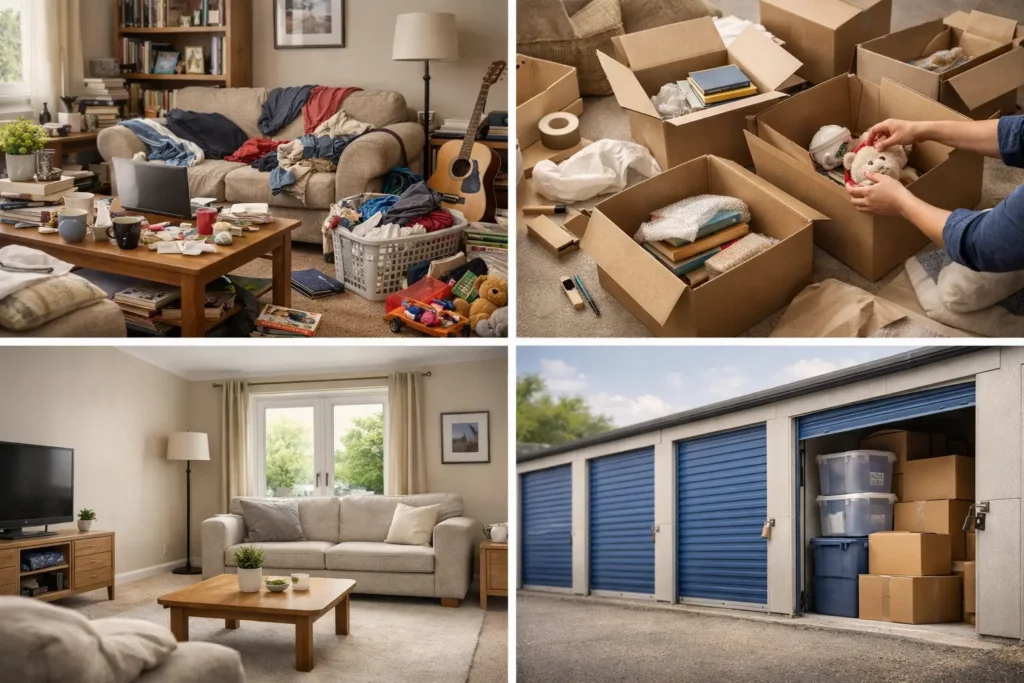
Alternatives to Moving House Most People Overlook
Once you start looking at the problem differently, alternatives begin to appear.
Clearing space properly (not just tidying)
There’s a difference between rearranging and removing.
Rearranging keeps the same volume of items.
Removing changes how the space feels.
If you want a deeper look at how to approach this properly, our guide on small home storage ideas explores how to create space without relying on constant rearranging.
Reconfiguring how rooms are used
A spare room filled with storage might be more useful as a dedicated workspace or living area.
Sometimes it’s not about gaining space but rather about reclaiming it.
Using a rotation approach
Instead of storing everything at once, rotate items based on use.
- seasonal clothing
- decorations
- hobby equipment
- archived files
This reduces the baseline level of “stuff” in your home.
Creating breathing room with external storage
In some cases, the most practical solution isn’t squeezing more into your home, it’s taking some things out of it.
External storage can provide space for:
- furniture not currently in use
- archived paperwork
- business supplies
- seasonal belongings
This isn’t about removing things permanently. It’s about creating flexibility.
If you’re considering this approach, you can find your nearest facility on our self storage locations page.
When Moving House Actually Makes Sense
Of course, not every situation can be solved without moving. There are times when moving house is the right decision.
For example:
- your home no longer meets long-term needs
- structural limitations prevent meaningful changes
- location no longer works for your lifestyle
The key is making that decision deliberately and not reactively.
A Practical “Before You Move” Reset Plan
Before listing your home or booking a viewing, try this:
Step 1: Remove non-essential items
Anything you don’t use weekly should be reviewed.
Step 2: Clear one room completely
Experience what the space feels like without pressure.
Step 3: Reintroduce only what’s necessary
Be intentional about what comes back.
Step 4: Repeat the process
Work through the house gradually.
This isn’t about decluttering everything. It’s about testing whether your home can work better with less inside it.
Final Thoughts Before Moving House
Moving house can be the right decision. But it’s also one of the most expensive and disruptive ones.
Before committing, it’s worth understanding the real problem you’re trying to solve. Because in many cases, the issue isn’t space. It’s how much is being asked of that space at any one time. And once that changes, everything else often becomes clearer.